The History of the Bikini: From Fallout to Sunlight
The history of the bikini begins with a place, not a garment.
Today, the word suggests sunshine, swimming pools, folded holiday clothes and the doomed annual belief that this will finally be the year in which nobody forgets the sun cream. It sounds light, summery and almost frivolous.
Its past, however, is anything but.
Louis Réard named the modern swimsuit after Bikini Atoll, a Marshallese homeland whose people the United States had displaced before beginning nuclear tests there. He chose the name because he wanted the launch to feel as explosive as the test that had dominated the news only days earlier.
Few garments carry an etymology quite so explosive.
Before the Bikini Was a Bikini
The history of the bikini did not suddenly begin in 1946. Ancient Roman mosaics show women wearing garments that resemble modern two-piece sportswear, while bathing suits with separate tops and bottoms had already appeared before the Second World War.
What changed in 1946 was the amount of fabric—and the name.
That summer, French designer Jacques Heim promoted a small two-piece swimsuit called the Atome, French for “atom”. He presented it as the world’s smallest bathing suit.
Atomic language already carried an extraordinary charge. The atom had escaped from physics laboratories and entered everyday speech as a symbol of modernity, danger and astonishing smallness.
Then Louis Réard made an even smaller swimsuit.
Réard had trained as a mechanical engineer before moving into his mother’s lingerie business. His design exposed the wearer’s navel, which separated it from many earlier two-piece bathing costumes. He needed a name capable of making Heim’s Atome sound almost restrained.
He found one in the news.
Bikini Atoll Becomes a Headline
Bikini Atoll lies in the Marshall Islands in the Pacific Ocean. The name belonged to a real homeland long before anyone applied it to swimwear.
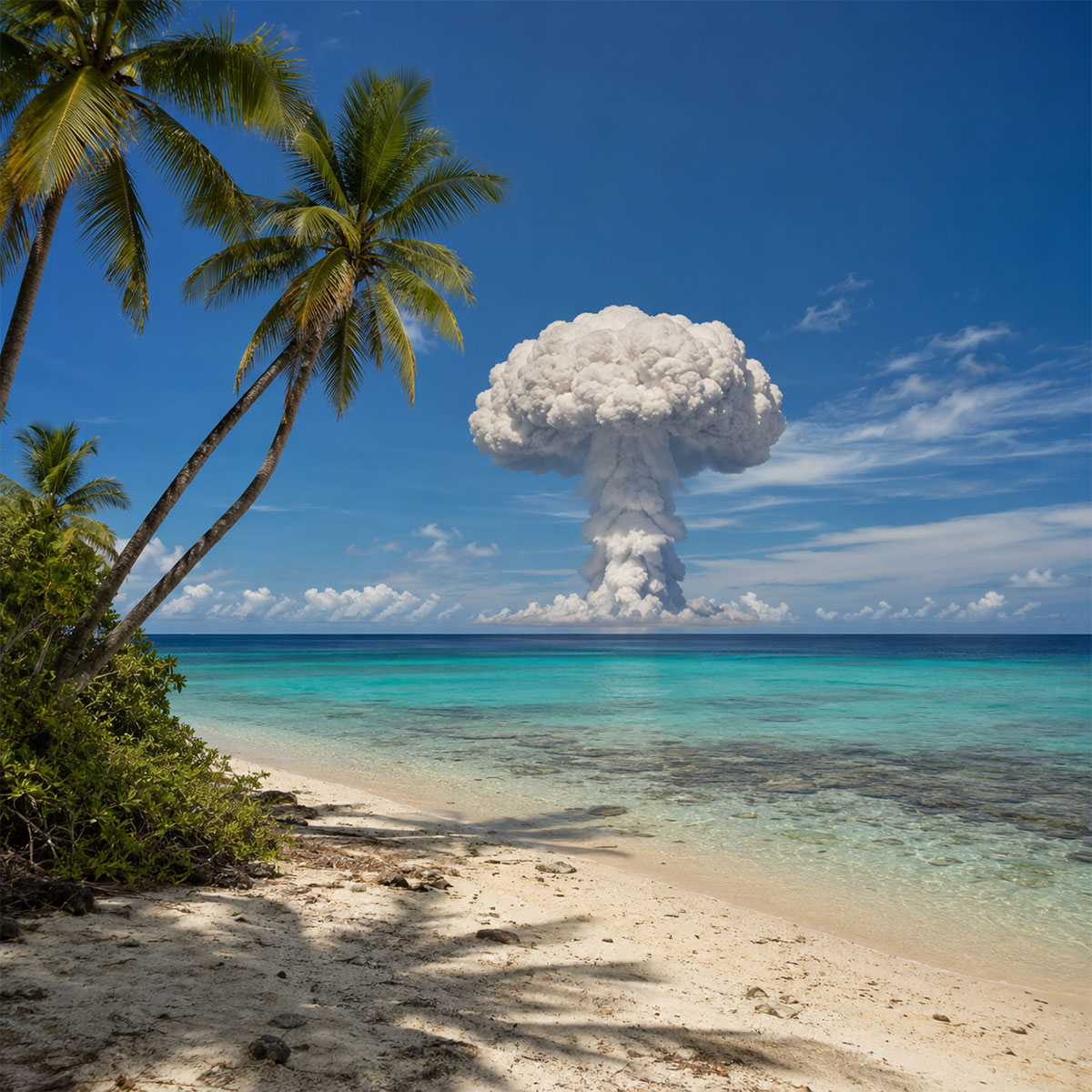
In March 1946, American authorities relocated the atoll’s inhabitants in preparation for Operation Crossroads, a nuclear weapons testing programme. On 1 July, the United States detonated the first test weapon, Able, above a fleet of target ships assembled in Bikini’s lagoon.
It was the first nuclear weapon exploded since the attacks on Hiroshima and Nagasaki.
The United States turned the test into a vast military and media spectacle. Ships, observers, reporters and cameras helped make Bikini one of the most recognisable place names of the emerging nuclear age.
Four days later, on 5 July 1946, Réard unveiled his swimsuit at the Piscine Molitor in Paris.
He called it the bikini.
The name invited an unmistakable comparison: this tiny garment would create an explosion of its own.
A Fashion Launch Built to Explode
Réard struggled to find a conventional fashion model willing to wear the design. Eventually, he hired Micheline Bernardini, a dancer from the Casino de Paris, to present it.
Bernardini wore a bikini printed with newspaper-style text, which turned the garment into its own front page. Réard expected scandal, coverage and public argument. Those were not unfortunate side effects. They formed the launch strategy.
In other words, the swimsuit did not merely borrow the name of a place. It borrowed the destructive power that global publicity had attached to that place.
“Bikini” was short, memorable and already charged with meaning. It suggested something new, dangerous and capable of disturbing the established order. Réard transferred that charge from a nuclear test to a piece of clothing.
The result was an astonishingly effective act of branding.
It was also an act of erasure.
The word travelled around the world, while the people whose homeland supplied it remained displaced. The United States eventually carried out 23 nuclear tests at Bikini Atoll between 1946 and 1958, leaving lasting consequences for the community, landscape and environment.
Meanwhile, the fashionable meaning became ordinary. The human history beneath it became comparatively invisible.
The Prefix That Never Existed
The word then performed another linguistic trick.
English speakers looked at bikini and saw what seemed to be a familiar element: bi-, meaning two. Because a bikini had two pieces, the division appeared perfectly logical:
bi + kini
There was only one problem.
That was not how the word had formed. The bi in bikini did not originally mean two; it was simply part of the place name.
Nevertheless, the misunderstanding became productive.
In 1964, designer Rudi Gernreich introduced the monokini. Its name replaced the imaginary bi- with mono-, meaning one. Later came the tankini, trikini, microkini, skirtini and an expanding wardrobe of other -kinis.
Linguists call this process reanalysis or rebracketing. Speakers mentally divide a word into new pieces, then use those pieces to construct further words.
Something similar happened to hamburger. The word originally described something associated with Hamburg. Later, English speakers divided it into ham + burger, allowing burger to escape and produce cheeseburgers, chicken burgers and veggie burgers.
In the same way, speakers dismantled an island name into a numerical prefix and a completely invented clothing suffix.
The error became more useful than the truth.
A Small Word Carrying Too Much
The history of the bikini compresses several different stories into six letters. The word names a Marshallese homeland, recalls American nuclear testing and preserves a French publicity stunt. It also belongs to the history of changing attitudes towards women’s bodies, public modesty and personal freedom.
At the same time, bikini became the accidental parent of a family of words built from a prefix that was never really there.
Most of us use the word without hearing any of this. That is normal. Language is full of buried histories, and repetition polishes words until we can no longer feel the rough circumstances of their creation.
However, the history remains inside them.
The bikini shows that etymology is not merely the search for charming old definitions. It can reveal displacement, commerce, fashion, misunderstanding and the strange ability of language to make catastrophe sound like summer.
A word may look perfectly ordinary while carrying an island, an explosion and an invented suffix beneath its surface.
That is why it pays to look twice.
Another everyday expression with a surprisingly constructed past appears in the surprising history of “OK”.
Continue into Uncommonology®
One unusual idea often leads to another. Begin the free Initial Certificate of Uncommonology® and take your first step into the study of uncommon knowledge.
Start the free Initial Certificate →
Already enrolled, or ready to create your account?