
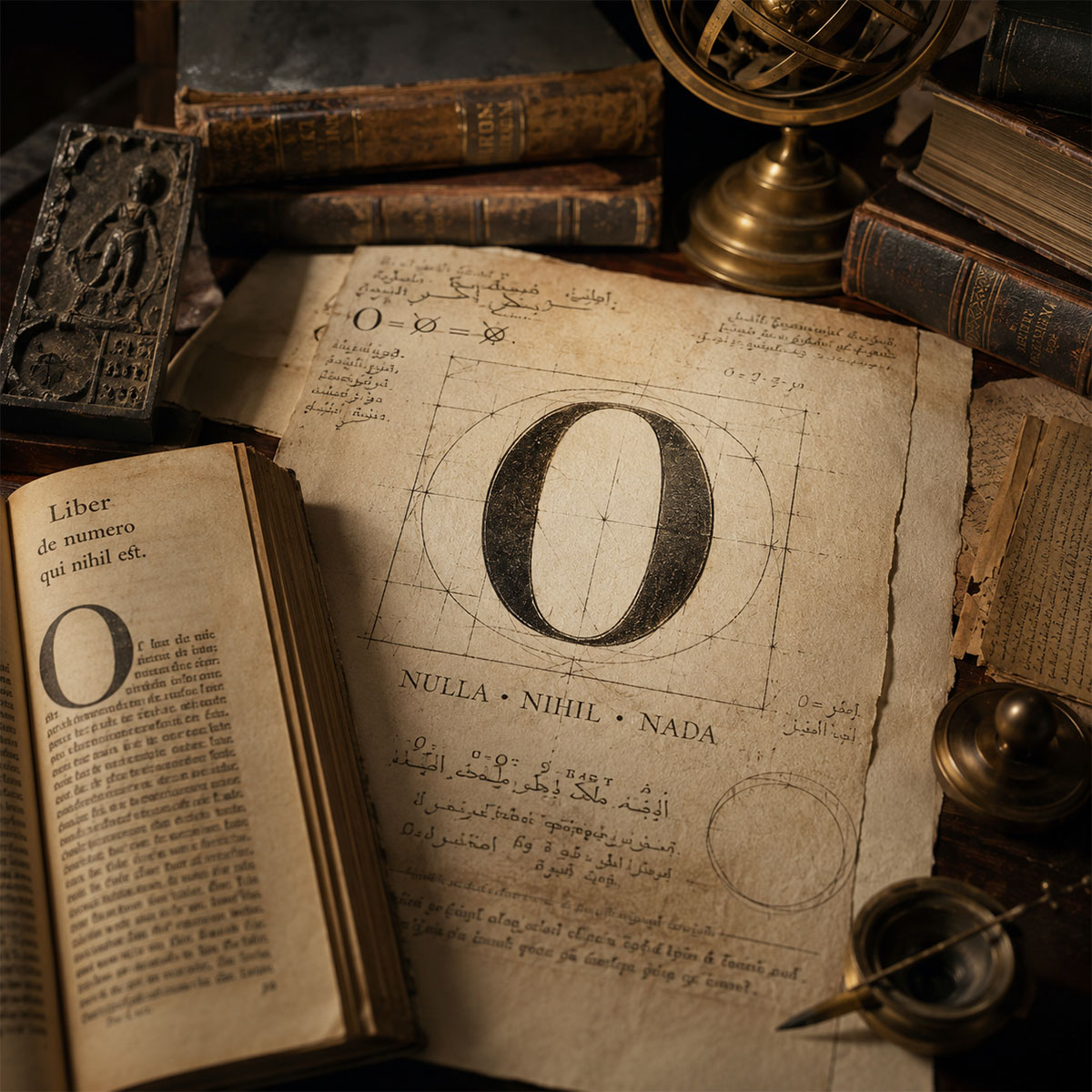
The Number That Wasn’t There
The history of zero begins with an empty place.
Today, zero sits quietly on keyboards, bank statements, thermometers and telephone numbers. It separates positive values from negative ones, preserves empty columns inside larger numbers and helps computers organise almost everything they do.
Yet human beings counted, traded, built and studied the heavens for thousands of years without treating zero as an ordinary number.
Different cultures solved different parts of the problem. Babylonian scribes marked empty positions. Maya mathematicians developed their own zero sign for calendrical calculations. Indian mathematicians then made the decisive conceptual leap: they allowed nothing to enter arithmetic.
Zero was not simply found waiting in the world. It had to be imagined, represented and persuaded to behave like a number.
The History of Zero Before Zero Was a Number
Early civilisations did not necessarily need a symbol for zero. A shepherd counting animals only needed words or marks for the animals that were present. If there were no sheep in a field, there was nothing to record.
Many numeral systems reflected that practical approach. Egyptian and Roman numerals contained signs for particular quantities, but they did not use a positional system like the one familiar to us today.
Roman numerals could record a result perfectly well. However, people often performed the calculation itself on counting boards or with physical counters. The written symbols and the calculating machinery were separate.
Consequently, the absence of zero did not make ordinary arithmetic impossible. It became a more serious problem when mathematicians needed to record large, complicated or precisely positioned values.
The Empty Place Inside a Number
Our decimal system gives a digit its value partly through its position. The 5 in 50 means five tens, while the same digit in 500 means five hundreds.
Zero allows an empty position to remain visible. It distinguishes 52 from 502 and 5,002 without requiring a different symbol for every possible quantity.
Babylonian mathematicians used a positional system based on sixty rather than ten. At first, an empty place could be represented only by a gap, which left some written numbers open to interpretation.
By around the fourth century BCE, Babylonian scribes were using a pair of wedge-shaped marks to show that an internal position was empty. However, they did not normally place this mark at the end of a number, nor did they treat it as a number that could participate fully in arithmetic.
It was an important zero-like device, but it remained primarily a piece of punctuation inside a numeral.
A Placeholder Is Not Yet a Number
This distinction is easy to miss. A zero digit and the number zero are closely connected, but they are not exactly the same idea.
A placeholder says, “nothing occupies this position.” A number must do more. It must have defined relationships with other numbers and produce consistent results when it enters a calculation.
Maya mathematicians also developed a zero symbol independently. Their vigesimal, or base-twenty, system used positional notation, while a shell-like sign represented an empty place in calendrical records.
Meanwhile, Chinese counting methods could use an unoccupied space among counting rods to indicate an empty position. A written circular zero appeared in Chinese mathematics later.
These developments show that no single culture woke up one morning and invented every aspect of zero. Instead, people repeatedly encountered the same underlying problem: sometimes an empty position must be recorded rather than ignored.
India Makes Nothing Calculate
The most influential transformation took place within Indian mathematics. Here, a placeholder associated with the Sanskrit idea of śūnya—emptiness or void—developed into a mathematical object in its own right.
In 628 CE, the mathematician and astronomer Brahmagupta set out arithmetic rules involving zero in his Brāhmasphuṭasiddhānta. He described zero as the result of subtracting a number from itself and explained how it behaved during addition and subtraction.
For example, adding zero to a number leaves that number unchanged. Subtracting zero has the same effect. Subtracting a positive number from zero produces a negative result.
These rules now appear elementary because every schoolchild encounters them. At the time, however, they represented a remarkable conceptual advance. Absence was no longer merely an empty box inside written notation. It had become something that mathematics could act upon.
Brahmagupta did not solve every difficulty. Division by zero remained troublesome, as it still is. Nevertheless, his work helped establish zero as part of a coherent number system rather than a convenient gap.
How Zero Travelled West
Indian mathematical knowledge travelled into the Islamic world, where scholars studied, explained and extended the numeral system.
During the early ninth century, the Persian scholar Muhammad ibn Musa al-Khwarizmi wrote about calculation with Indian numerals. Although his original arithmetic treatise no longer survives in Arabic, later Latin versions helped carry its methods into Europe.
Al-Khwarizmi’s influence can still be heard in the word algorithm, which developed from a Latinised form of his name.
The numerals themselves also changed shape as they moved through different regions and writing traditions. The forms eventually adopted in Europe came through the western Islamic world, which is why they became known there as Arabic numerals despite their Indian origins.
Therefore, zero did not travel alone. It arrived as part of a much more powerful positional system in which ten small signs could represent quantities of almost any size.
Why Europe Adopted Zero Slowly
Europe did not immediately abandon Roman numerals, counting boards and established commercial practices. Familiar systems had institutions, teachers and habits behind them, even when a newer method offered clear advantages.
One important advocate was Leonardo of Pisa, now better known as Fibonacci. He had encountered the arithmetic used around the Mediterranean and recognised its practical value.
In 1202, his Liber Abaci presented the nine Indian figures together with the sign zero to a European readership. The book demonstrated their use through problems involving prices, profit, currency conversion, weights and trade.
For merchants, the attraction was not philosophical. Positional numerals made written calculation more flexible and allowed complex transactions to be handled more efficiently.
Even so, adoption remained gradual. Manuscripts had to be copied by hand, instruction varied from place to place, and many people continued using the methods they already understood.
Zero became ordinary not through one moment of triumph but through generations of calculation, teaching and practical use.
The Number Inside the Modern World
Once established, zero became difficult to remove from almost any advanced branch of mathematics.
It serves as the additive identity: a number can be added to zero without changing. It marks the boundary between positive and negative values and provides the origin from which coordinates can be measured.
Algebra uses zero to express equations in a standard form. Calculus depends heavily on quantities approaching zero. Science uses zero points, reference levels and null results to describe conditions with precision.
Computing gives zero another central role. Binary notation represents information using two symbols, conventionally written as zero and one. Those symbols can correspond to contrasting physical states inside electronic systems.
Consequently, documents, photographs, music, financial records and messages can all be represented through patterns containing a sign whose original purpose was to mark an empty place.
Zero Is Not Nothing
Everyday language often treats zero and nothing as interchangeable. Mathematically, however, zero is not the absence of a number. It is a number that represents the absence of quantity.
That distinction gives it remarkable power. An empty page contains no written number, but a written zero communicates precise information. A bank balance of zero is different from an unknown balance, a missing record or an account that does not exist.
Zero can mark a beginning, a boundary, a completed subtraction or a deliberately measured absence. It allows nothing to be compared, positioned and included in a calculation.
The history of zero is therefore not simply the story of a symbol shaped like a small circle. It is the story of a change in thought.
Human beings learned that absence need not remain blank. It could be given a place, a name and a set of rules—and, once that happened, nothing began to count.
Continue into Uncommonology®
One unusual idea often leads to another. Begin the free Initial Certificate of Uncommonology® and take your first step into the study of uncommon knowledge.
Start the free Initial Certificate →
Already enrolled, or ready to create your account?