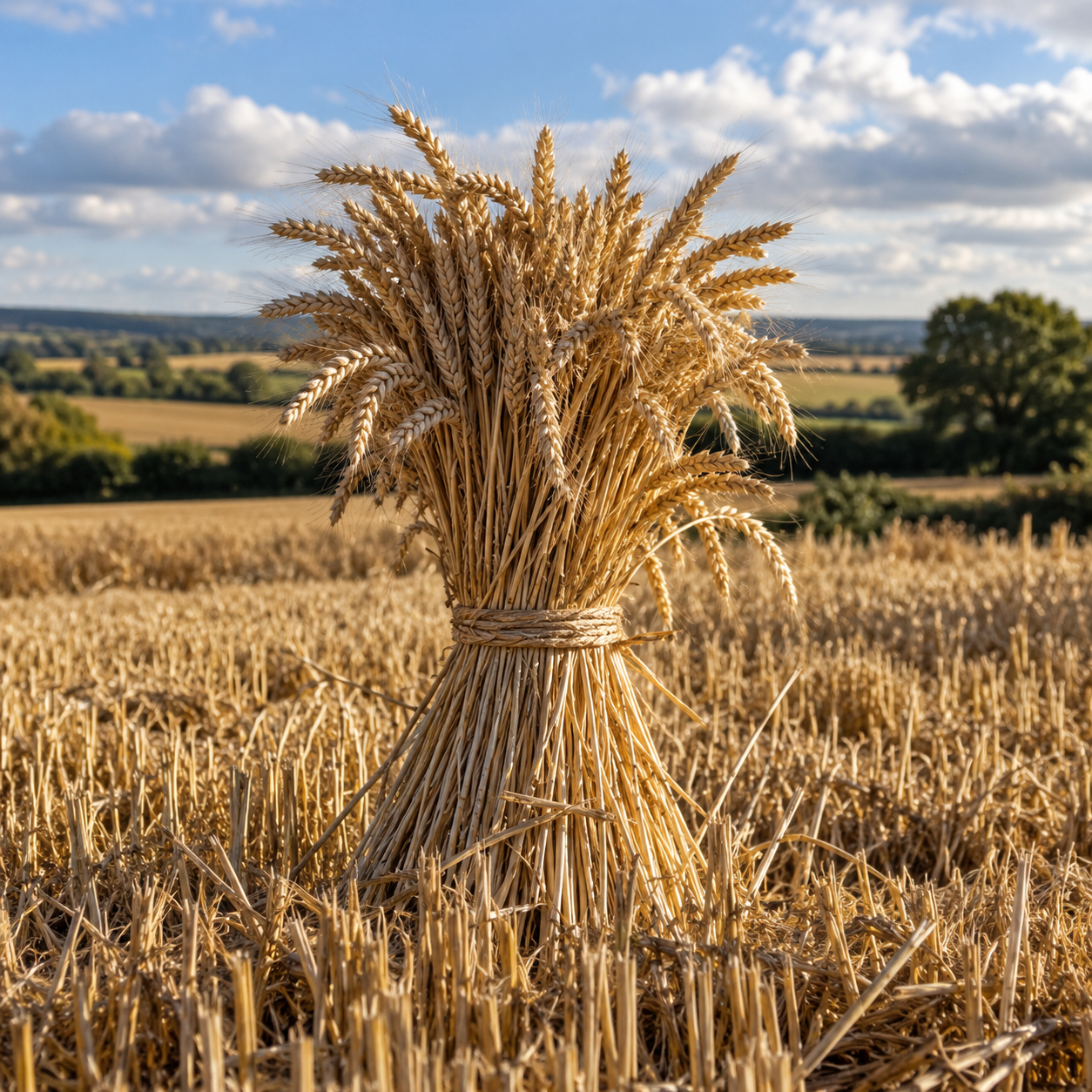
For most of the harvest, a bundle of grain was simply part of the work.
The last one could be something else entirely.
Across parts of Britain, the final corn cut from a field attracted customs that transformed a few stalks of wheat or barley into an object worth shouting about, decorating, carrying home and keeping long after the harvest itself was finished.
In Cornwall and Devon, one version became known as “Crying the Neck”. Elsewhere, the last corn acquired different names, ceremonies and stories.
The harvest ended when the field was empty. The story of its final handful was only beginning.
Why the Last Cut Mattered
Before mechanised harvesting, bringing in a cereal crop was an intensely physical and communal operation. Reapers moved across a field with sickles or scythes, cutting the standing crop and gathering it into sheaves. The work could occupy many people and stretch over a considerable period.
That gave the final patch of standing grain an obvious significance. It marked a boundary: on one side was a crop still exposed in the field; on the other was a harvest safely brought in.
And humans are remarkably good at turning boundaries into ceremonies.
Historical accounts from different parts of Britain and Ireland record customs associated with the last corn, although the details vary considerably. Sometimes the final handful was cut in a particular way. Sometimes it received a special name. Sometimes it was made into a decorated object. Sometimes its arrival home became part of the harvest celebration.
There was no single British “last sheaf ritual”. What existed was a family of local traditions built around the same wonderfully simple fact: eventually, somebody had to cut the final stalk.
Crying the Neck
One of the best documented versions comes from Cornwall and Devon, where the final corn became associated with a ceremony known as “Crying the Neck”.
Nineteenth-century descriptions record workers gathering after the cutting was finished while a small bundle of selected ears was held aloft. Calls passed between the person holding it and the assembled harvesters, announcing that they had “the neck”. The ceremony could finish with cheering, singing and the journey back from the field.
The precise form varied. Margaret Ann Courtney’s nineteenth-century account of Cornish customs describes the neck being made into a miniature sheaf, decorated with flowers and ribbons and carried home. She also records the wonderfully less-than-solemn possibility of its bearer racing towards the farmhouse while someone waited with a bucket of water.
The Museum of Cornish Life notes that the historical record is complicated. Versions of the custom were recorded in the nineteenth century, but the practice later declined and was deliberately revived in Cornwall during the twentieth century by the Old Cornwall movement. Modern Crying the Neck ceremonies therefore preserve an older custom, but they are also part of a conscious revival of Cornish tradition.
That makes the custom more interesting, not less. Traditions do not have to survive unchanged to survive at all.
The Sheaf That Came Indoors
Cutting the last corn did not necessarily finish its usefulness.
In one Cornish account, the decorated neck was hung from a beam in the kitchen and remained there until the following harvest. Another tradition recorded in East Cornwall kept it until Christmas Day, when it was given to the best ox in the stalls.
Think about what has happened to the object by this point. Grain that began as part of an agricultural crop has crossed into the house. Instead of being immediately threshed, eaten or sold, it has been deliberately preserved.
That preservation has encouraged generations of folklorists to ask what people believed the last sheaf represented.
Some writers interpreted such customs through the idea of a “corn spirit”: a supernatural presence imagined as retreating into the remaining grain as the field was cut, eventually becoming concentrated in the final standing stalks. On that interpretation, preserving the last sheaf provided the spirit with somewhere to remain until the next growing season.
It is an appealing explanation. It should not, however, be mistaken for a universally documented belief held by every community practising these customs. Folklore collected at different times was often interpreted through the theories fashionable among the scholars recording it.
The ceremony is historical. A single explanation for exactly what it originally meant is much harder to establish.
From Last Sheaf to Corn Dolly
The connection becomes more familiar when straw is turned into a shape.
Objects now commonly called corn dollies were made by plaiting, twisting or binding cereal straw into decorative forms. Museums preserve examples ranging from relatively simple bundles to elaborate geometric constructions.
The Museum of Cambridge, for example, holds a windmill-shaped corn dolly made in 1949 for a harvest festival in Meldreth. Its collection history links the object with traditions surrounding the last sheaf and beliefs about preserving the fertility of the crop.
But “corn dolly” can be a deceptively tidy modern label. Harvest straw work developed in different places, at different times and in many forms. Not every decorative straw object had precisely the same purpose, and not every last-sheaf ceremony necessarily produced what we would now recognise as a corn dolly.
What they share is the transformation.
A material normally valued because it feeds people becomes valuable because it means something.
The Problem With Ancient Traditions
This is where an innocent bundle of wheat can lead us into one of folklore’s most useful lessons.
Older writers were often eager to connect rural customs directly to a remote pagan past. A peculiar ceremony involving grain might be described as the survival of an ancient fertility rite, a sacrifice, a vegetation god or a pre-Christian agricultural religion.
Sometimes those interpretations may preserve useful clues. But a custom recorded in the eighteenth or nineteenth century does not automatically provide an unbroken window into the Iron Age.
Even eyewitnesses could speculate. An 1836 description by Eliza Bray of a Crying the Neck ceremony near Dartmoor interpreted what she saw as a survival of ancient religious practice. Her account is valuable evidence that the ceremony occurred; her explanation of its ultimate origin is an interpretation.
Later history adds another layer. The Museum of Cornish Life traces the organised revival of Crying the Neck in Cornwall to the Old Cornwall movement in the 1920s. A practice can therefore be old, decline, be rediscovered, be reconstructed and acquire new meanings while still feeling deeply traditional.
Folklore rarely behaves like an artefact sealed behind museum glass. People keep touching it.
What Happened When the Machines Arrived
The physical conditions that created these customs changed dramatically with agricultural mechanisation.
A combine harvester does not approach the last few stalks with quite the same theatrical possibilities as a line of people working across a field by hand. The communal moment in which everyone knows that one particular person is about to make the final cut becomes much harder to preserve.
Unsurprisingly, many last-sheaf customs declined as the work itself changed.
Yet Crying the Neck did not disappear completely. Revived ceremonies continue to be held in Cornwall, where local organisations have made the ritual part of a modern celebration of Cornish culture and harvest.
The meaning has shifted. A ceremony once embedded in agricultural labour can now function as heritage: something performed partly because people have decided that remembering it matters.
The Afterlife of the Last Sheaf
That may be the strangest part of the story.
The last sheaf survived its own disappearance.
The agricultural world that produced many of these customs has changed almost beyond recognition. Hand reaping is no longer the normal rhythm of the British harvest. The people standing in a modern field are unlikely to depend upon the final sweep of a sickle to announce that months of work have reached their conclusion.
Yet the little bundle remains — in museum collections, in revived ceremonies, in straw craft and in the vocabulary of harvest tradition.
Perhaps that persistence tells us something larger about ritual. Human beings do not merely notice endings. We give them objects, words and actions. We ring bells, raise glasses, cut ribbons, throw hats into the air and keep things that would otherwise have been discarded.
Once, at the edge of a newly emptied field, that object could be the final handful of corn.
The harvest was over.
But somebody carried the last piece of it home.
Continue into Uncommonology®
One unusual idea often leads to another. Begin the free Initial Certificate of Uncommonology® and take your first step into the study of uncommon knowledge.
Start the free Initial Certificate →
Already enrolled, or ready to create your account?