The Stone That Watched for Poison
Imagine sitting down to a magnificent meal while wondering whether someone had poisoned it.
You could watch the servants, inspect the wine or wait for another guest to take the first mouthful. However, a wealthy diner with the right piece of jewellery had another option: glance at the ring on their hand.
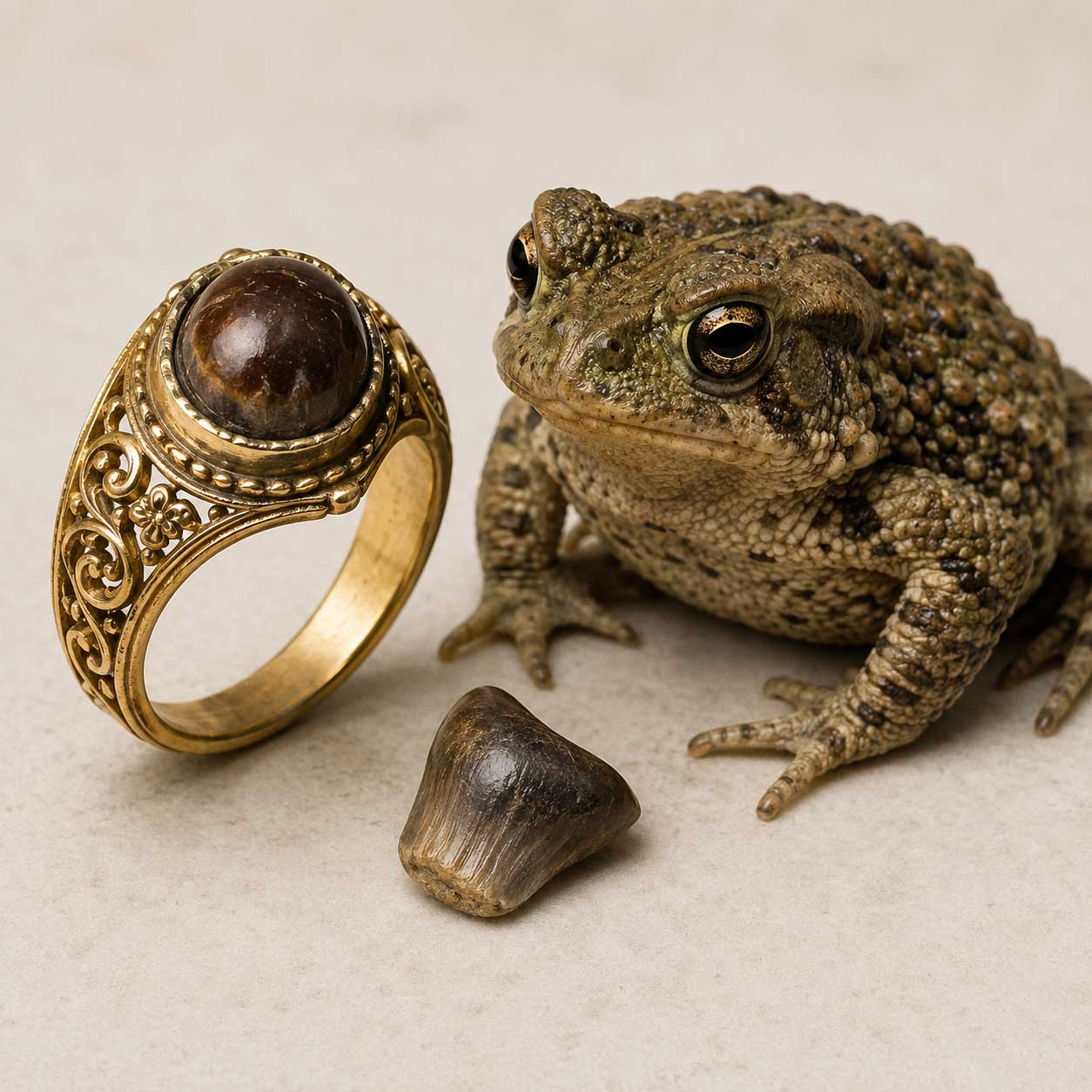
That ring might contain a small, rounded object known as a toadstone. People claimed that toadstones grew hot, changed colour or produced beads of moisture whenever poison came near. Owners also pressed them against bites and wounds in the hope that they would draw venom from the body.
According to generations of writers, jewellers and customers, the stone formed inside the head of a very old toad.
It did not. In most cases, the supposed jewel was the fossilised crushing tooth of a fish that had lived millions of years before either rings or people existed.
A Jewel Where No Jewel Existed
Toads occupied an uncomfortable corner of the European imagination. Their bodies looked cold, squat and damp. Some species produced irritating or poisonous secretions, while their habit of appearing in gardens, cellars and shadowy places encouraged darker associations.
Over time, people linked toads with venom, medicine, witchcraft and transformation. From this unpromising animal came the idea of a hidden jewel.
The same creature that supposedly carried poison also carried its remedy. Somewhere inside its head, believers imagined, lay a stone that could warn its owner of danger and counteract harmful substances.
The object acquired several names. English speakers called it a toadstone. Latin writers used lapis bufonis, meaning the stone of the toad. French speakers knew it as a crapaudine.
Descriptions varied. Some authors mentioned brown or reddish examples, while others described greenish or black stones. A pale or blue spot sometimes appeared on the surface and resembled a tiny eye.
The stone’s shape helped the story survive. Most examples looked small, smooth and rounded on top. Their undersides often appeared hollow or flat. To an observer without modern geological knowledge, the object looked organic, polished and mysterious.
Finding one presented a greater problem.
How to Persuade a Toad to Surrender Its Treasure
Some instructions insisted that the collector had to remove the stone while the toad remained alive. Once the animal died, the jewel supposedly lost its power.
One method involved a piece of red or scarlet cloth. The collector placed the toad on the fabric because, according to the story, the colour pleased or distracted the animal. The toad would then stretch out, release the stone from its head and try to swallow it again.
A more elaborate version added a hidden hole beneath the cloth. When the toad released its treasure, the stone would fall into a vessel of water. The animal, reluctant to enter the cold water, would then abandon it.
Believers also developed tests for separating genuine stones from imitations. They placed the suspected jewel before a living toad and watched its reaction. A toad that raised its head towards the object confirmed its authenticity. If it moved away, the buyer had probably acquired a fake.
Not every observer accepted these claims.
The physician and mineralogist Anselmus Boetius de Boodt reportedly tested the red-cloth method himself. He placed an old toad on the fabric and watched it through the night.
Nothing happened. The toad neither produced a jewel nor rewarded the patience of the exhausted natural philosopher.
Even so, scepticism did not destroy the belief immediately. Some writers rejected the idea that stones grew inside toads but continued to defend the objects’ powers. Others suggested that toads created them outside the body or deposited a mysterious substance on one another’s heads.
Once an object gains a strong reputation, people do not always abandon every claim when one explanation fails.
The Stone That Could Smell Danger
The toadstone’s most celebrated talent involved poison detection. Supporters claimed that it would sweat, heat up, change colour or burn the wearer when a dangerous substance approached.
Such claims appealed to people who feared hidden poison. A cup, plate or gift might conceal a threat that the eye could not detect. A responsive stone offered a portable warning system.
Its supposed value extended beyond the dining table. Owners pressed toadstones against snake bites, insect stings and wounds. Some healers claimed that the stones drew poison from the flesh or reduced swelling.
Medical writers recommended them for an even wider range of complaints. These included kidney disease, bladder stones, epilepsy, stomach pains and bowel disorders.
One medieval remedy advised the patient to swallow the stone. After it had passed through the body, the owner could retrieve it and keep it for future use.
Modern readers may find that instruction alarming. Yet the toadstone belonged to a medical world in which minerals, animal parts, herbs, prayers and protective charms often overlapped. Treatment could combine physical, spiritual and symbolic ideas without a clear boundary between them.
The belief also answered a genuine human need. Poison could remain invisible until it caused harm. The stone promised to make hidden danger reveal itself.
The Prehistoric Fish Beneath the Folklore
The real origin of toadstones leads to an even stranger story.
Most examples came from the fossilised crushing teeth of extinct fish, often described in older museum records as Lepidotes or closely related forms. These heavily armoured fish lived during the age of the dinosaurs.
Instead of sharp teeth for tearing flesh, they possessed rounded teeth suited to crushing shells and other hard food. Their shape already resembled a tiny domed stone.
After the teeth separated from the jaw and fossilised, they could survive in rock for millions of years. Eventually, someone might find one, polish it and mount it in jewellery.
A jeweller did not need to carve a larger gemstone into shape. Biology and geology had already created a small, durable object with a smooth curved surface.
Modern palaeontology identifies the object as part of an extinct fish. Earlier observers placed it inside the head of a living toad. Both explanations began with the same peculiar object, but they belonged to completely different views of nature.
Before modern geology developed, people did not always recognise fossils as the remains of ancient organisms. An unusual object found in stone might appear to be a failed form of life, a product of the earth, something created by lightning or a fragment from a familiar animal.
The toadstone story therefore represented more than a simple mistake. People tried to fit an unfamiliar natural object into an explanation they already understood.
The stone looked organic. Its surface resembled a jewel. Toads already carried associations with poison. The theory appeared to fit, provided nobody expected the toad to cooperate.
Rings That Outlived the Belief
Museum collections show how seriously people treated toadstones.
The British Museum holds several medieval and early modern rings set with fossil fish teeth. Goldsmiths and silversmiths mounted them in rings from at least the fourteenth to the seventeenth century.
Some settings look plain and practical. Others feature elaborate metalwork, inscriptions or symbols intended to strengthen the stone’s protective power.
One fourteenth-century Italian ring combines a toadstone with words associated with protection. Its owner may have worn it against poison, kidney disease or both.
Such objects brought several worlds together. Jewellery, medicine, religion, natural history and folklore all met on a single finger.
The Ashmolean Museum also preserves charm rings containing toadstones. These were not rough curiosities left in drawers. Skilled craftspeople selected, polished and mounted them as valuable objects.
Loose examples also appeared among the gemstones of the Cheapside Hoard, a remarkable collection hidden in London during the late sixteenth or early seventeenth century.
One polished specimen now held by the London Museum formed roughly 150 million years ago. Human hands later worked it for use in early modern jewellery.
That object carries an extraordinary sequence of events. A tooth formed in the mouth of a Jurassic fish. It survived inside rock for an immense period. Someone dug it from the ground, polished it and introduced it into the London jewellery trade as a stone from a toad.
Deep time had become merchandise before anyone understood that deep time existed.
Shakespeare’s Precious Jewel
The belief became familiar enough to appear in one of the best-known works of English literature.
In As You Like It, Shakespeare refers to the supposedly ugly and venomous toad carrying a precious jewel in its head. He uses the image to suggest that something unpleasant may conceal an unexpected benefit.
The comparison worked because audiences recognised the story. Shakespeare did not need to pause and explain what a toadstone was.
That familiar image also helped the belief endure. Even when naturalists questioned the stone’s origin, the metaphor retained its power.
A repellent animal carried treasure. Ugliness concealed value. Poison contained its own remedy. A doubtful piece of natural history had become a useful piece of language.
Shakespeare did not prove that jewels grew inside toads. Instead, his words preserved evidence that many people knew and understood the claim.
When a Fossil Becomes Medicine
The toadstone belongs to several histories at once.
Palaeontology identifies it as a fossil. Jewellery history records its use in rings and amulets. Medical history preserves claims about poison and disease. Folklore explains how people imagined its origin and powers.
Most importantly, the object shows how something can acquire a full identity before anyone understands what it really is.
People did more than mislabel fossil teeth. They invented procedures for extracting them, tests for authenticating them and instructions for using them. Jewellers then gave those stories permanent settings in gold and silver.
Scientific explanation eventually removed the toad from the story. However, it did not make the object ordinary.
A fossil fish tooth remains remarkable even if it never sweated beside a poisoned cup. It preserves part of an animal from a vanished world and shows how people interpreted fossils before they understood their true age.
For centuries, owners looked at their rings and believed they wore jewels taken from the heads of toads.
In reality, they wore the mouths of the Jurassic.
Continue into Uncommonology®
One unusual idea often leads to another. Begin the free Initial Certificate of Uncommonology® and take your first step into the study of uncommon knowledge.
Start the free Initial Certificate →
Already enrolled, or ready to create your account?