Some old buildings have been trying to tell us something for centuries.
Look closely at their wooden beams, stone doorways and plaster walls and you may find circles cut with a compass, overlapping letters, repeated lines, five-pointed stars or small areas of deliberate scorching.
They are easily dismissed as graffiti. Sometimes that is exactly what they are. Others are builders’ marks, measurements or decoration.
But some appear repeatedly in places that once mattered very much: beside doors, around windows, above fireplaces and close to other openings into the home.
These are often called “witch marks”. The name is memorable. The reality is considerably stranger.
Marks Made to Turn Danger Away
A more careful name for many of these symbols is apotropaic marks — markings intended to turn away harm or evil.
Examples survive in houses, churches, barns and other historic buildings across Britain. Many belong to the long period in which fears about witchcraft, malicious spirits, sudden fire, illness and unexplained misfortune formed part of ordinary life.
Calling them “witch marks” can therefore give the wrong impression. They were not necessarily left by witches, nor do they provide evidence that the people making them were secretly practising witchcraft. Quite the opposite: where a protective interpretation is correct, the mark was intended to defend a person, possession or building against something feared.
There was rarely a neat boundary between a practical precaution and a symbolic one. A household might secure a door with a heavy bolt while also placing a protective sign beside it. One dealt with an intruder who could be seen. The other addressed dangers that could not.
Why Openings Attracted Protection
The position of the marks is often as interesting as the design.
Doors, windows and fireplaces repeatedly attract unusual carvings. These are all openings: points where the protected interior of a building meets something beyond it.
A doorway allows friends to enter, but it also admits strangers. A window brings in light and air while making a hole in the wall. A chimney carries smoke safely out of the house, yet it creates a permanent passage between the room and the world above the roof.
To people concerned about supernatural danger, these vulnerable boundaries could acquire an additional significance. If harmful forces were imagined as capable of entering a house, then the places already designed for things to pass through were obvious areas to guard.
The same logic can be seen in other historic customs. Objects including shoes, charms and other unusual deposits have been discovered concealed near chimneys, floors, walls and thresholds. The architecture of the building became part of the protective system.
A wall kept the weather out. A mark on the wall might be expected to do rather more.
The Daisy Wheel Drawn With Compasses
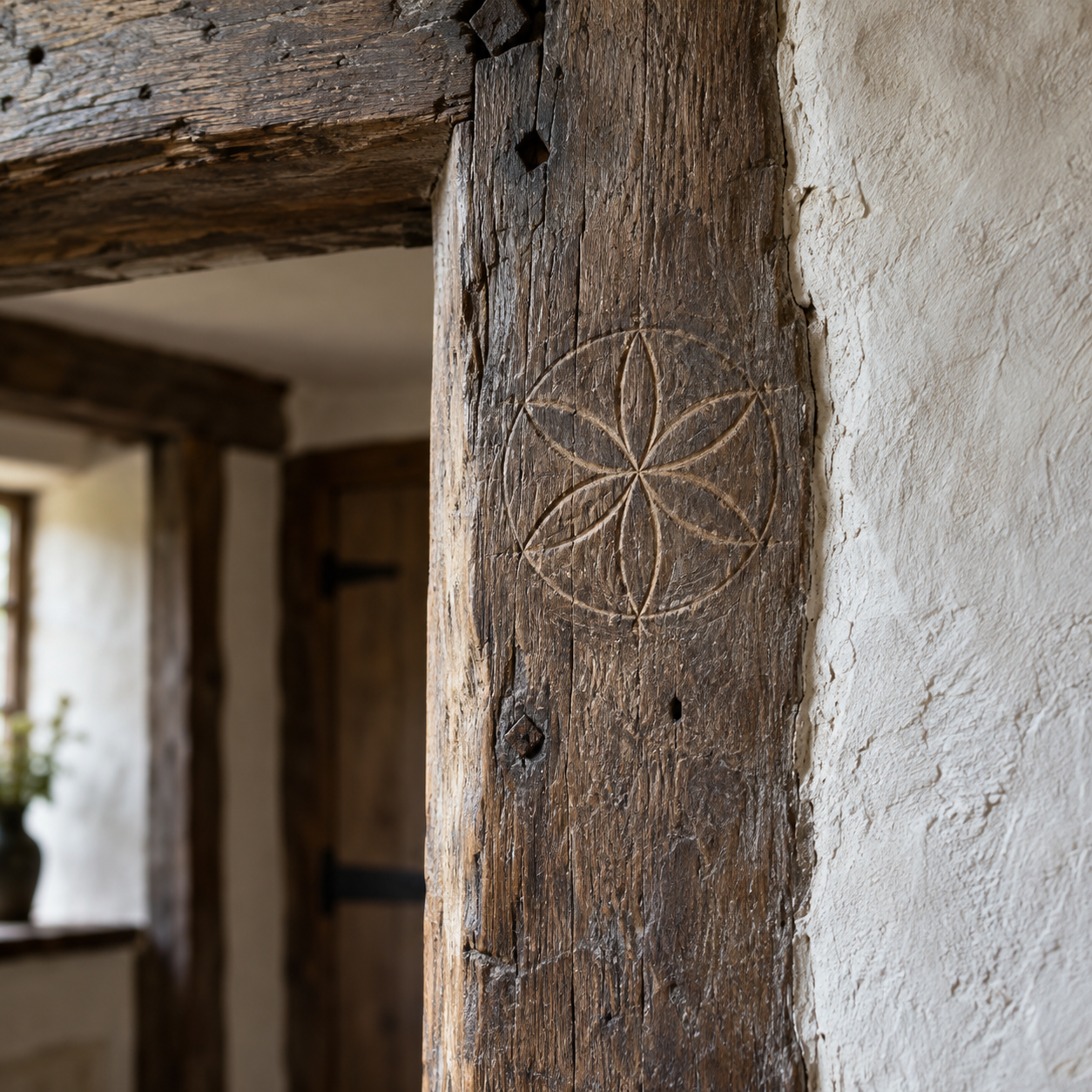
One of the most recognisable designs is the daisy wheel, usually described by researchers as a hexafoil.
At first glance it resembles a simple six-petalled flower enclosed within a circle. Look more closely and its geometry becomes apparent. The design can be produced using a compass or pair of dividers, repeating arcs of the same radius around a central point.
That simplicity helped the pattern travel across centuries. Hexafoils appear on timber, stone, plaster and occasionally objects and furniture. They can occur singly or in groups, sometimes overlapping into much more complicated arrangements.
The difficult part is deciding what they meant.
A hexafoil might have been decorative. It might have been a geometry exercise or the work of someone testing a tool. In some locations, however, its placement and repetition have led researchers to interpret it as a protective symbol.
One theory is that the continuous geometry itself mattered. An evil force entering the pattern could symbolically be trapped or confused within its repeating lines.
Whether anyone who made a particular daisy wheel actually thought in precisely those terms is harder to prove. That uncertainty is important. A symbol that looks identical in two different buildings does not automatically have the same purpose.
Letters That May Have Invoked Mary
Some marks look less like geometry and more like handwriting.
Among the most discussed are combinations resembling an M, a pair of overlapping Vs, or the letters AM. These are frequently described as Marian marks because researchers have associated them with the Virgin Mary.
AM has been interpreted as an abbreviation of Ave Maria. Joined Vs have sometimes been read as Virgo Virginum — “Virgin of Virgins” — while a simple M has naturally been associated with Mary herself.
If those interpretations are correct, scratching such a symbol into a building could have functioned as a small invocation of protection.
But this is one of the areas where certainty quickly becomes dangerous.
Historic England notes that the meaning of these marks remains disputed. A pair of lines that resembles a devotional symbol may have had another function entirely, and changes in religious practice during the sixteenth century make simple explanations particularly difficult.
The marks are fascinating partly because they resist the temptation to translate every scratch into a tidy sentence.
Not Every Scratch Was Magical
Old buildings accumulate marks for perfectly ordinary reasons.
Carpenters working on timber-framed buildings marked individual pieces so that complicated frames could be assembled correctly. These markings often resemble Roman numerals and were practical instructions rather than supernatural protection.
Masons left working marks. Owners altered buildings. Children scratched surfaces. Visitors added initials. Craftspeople practised geometry. Generations of repairs introduced another layer of cuts, holes and scars.
This creates a problem for anyone hunting “witch marks”: once you expect to find mysterious symbols, almost any old scratch can start to look significant.
Context matters more than excitement.
A repeated group of symbols concentrated beside a doorway deserves different attention from a single random mark in the middle of a wall. A design hidden during construction raises different questions from initials scratched in a public place. Tool marks, position, repetition, date and the history of the building all matter.
The most interesting interpretation is not automatically the correct one.
Sometimes a line scratched into a beam is simply evidence that a carpenter was trying to remember which piece went where.
When Burning the Timber May Have Protected It
Some of the strangest possible protection marks were not scratched at all.
Historic timbers can contain small elongated burn scars, sometimes shaped rather like a teardrop or tadpole. They were once commonly explained as accidental damage caused by candles or tapers placed too close to the wood.
That explanation becomes less convincing when similar burns appear in places where nobody would sensibly put a light: high in roof structures, beneath floors or on timbers that were difficult to reach once the building was complete.
Experimental work and the distribution of the marks have led researchers to suggest that at least some were created deliberately.
One interpretation is particularly pleasing in its apparent contradiction.
The building may have been deliberately burned in a controlled way in an attempt to protect it from destructive fire or lightning.
To modern eyes, scorching a wooden house to prevent it burning down sounds backwards. Symbolic protection does not always operate through modern engineering logic, however. A small controlled encounter with the feared danger may have been understood as a way of guarding against the uncontrolled version.
The scorch mark then becomes both damage and defence.
Pentangles With a Different Reputation
Other marks are especially easy to misread because their modern associations have changed.
The five-pointed star or pentangle is a good example.
Popular culture can now make such a symbol appear sinister, occult or threatening. Historically, however, the pentangle has carried many different meanings, including protective ones.
Examples found on historic buildings therefore cannot safely be interpreted through modern horror films, contemporary occult imagery or assumptions about devil worship.
For someone carving a continuous five-pointed figure centuries ago, the unbroken line itself may have carried protective importance. As with circular designs, the pattern could be understood as something capable of confusing or containing unwanted forces.
The symbol has not changed shape.
Our expectations have.
What the Marks Reveal About an Old House
It is tempting to look at these carvings as evidence of a more superstitious age and congratulate ourselves on having escaped it.
That misses the most interesting part.
The people who lived in historic buildings faced genuine uncertainty. Houses burned. Crops failed. Children became sick. Lightning struck. Animals died. Food spoiled. Accidents arrived without explanation and medicine could often offer little help.
A protective mark did not have to replace practical action. It could exist beside it.
People maintained roofs, barred doors, tended fires and stored food carefully while also participating in customs intended to make uncertain places feel safer. The marks belong to that wider human attempt to place some order around things that could not be controlled.
That makes the smallest scratches surprisingly intimate.
Grand houses preserve portraits, furniture and records of their wealthy owners. A faint symbol cut beside a fireplace may preserve something different: a private concern, an old habit or a moment when an otherwise unknown person stopped with a knife, compass or tool and added one more layer of protection to the room.
Centuries later, the door remains. The danger they imagined has changed. The mark is still there.
Continue into Uncommonology®
One unusual idea often leads to another. Begin the free Initial Certificate of Uncommonology® and take your first step into the study of uncommon knowledge.
Start the free Initial Certificate →
Already enrolled, or ready to create your account?