A Language with Only Seven Pieces
Most languages begin in mouths. Solresol began in a notebook.
They grow through generations of speech, argument, trade, migration, misunderstanding and invention. Words accumulate slowly. Grammar develops habits. Spelling becomes a museum of pronunciations that people stopped using centuries ago.
Solresol began differently.
Jean-François Sudre deliberately constructed it from just seven musical notes.
He designed a language that people could speak, sing, play, display as colour or communicate through signals.
Seven familiar syllables formed its foundation: do, re, mi, fa, sol, la and si.
Those seven notes had to perform everything normally expected of an entire language. Different combinations formed words, while longer sequences expressed questions, actions, objects, emotions and ideas.
People could speak the words aloud, sing them as melodies or play them on a musical instrument. They could also write the same message in musical notation or represent it through numbers and colours. Later versions and extensions added symbols and hand signs.
This was not merely a spoken language with a musical quality.
It attempted to separate language from any single method of communication.
A sentence could begin in the human voice, move into a violin and become a row of coloured marks. A sequence of gestures could then repeat it. The order of the notes remained constant even when the physical form changed.
This ambition made Solresol one of the strangest and most ambitious constructed languages ever devised.
It did not simply ask whether everyone in the world could speak the same language.
It asked whether everyone needed to speak at all.
The Musician Who Wanted Music to Speak
Jean-François Sudre, a French violinist, composer and music teacher born in 1787, created Solresol. He began developing the language during the early nineteenth century and refined it for several decades.
Sudre started from an attractive idea. Human languages divide people because their words, sounds and writing systems differ. Music, he believed, offered something more widely recognisable. A musical note did not first require translation from French into English, Italian or Russian.
If music could cross borders, perhaps meaning could travel with it.
Sudre originally called his invention the Langue musicale universelle: the Universal Musical Language. One of its note combinations supplied the name Solresol, which eventually came to identify the whole system.
He did not keep the project confined to notebooks and theoretical diagrams. Sudre and musicians trained in his system conducted public demonstrations. One person could ask a question, while another answered through a sequence played on a violin.
Audiences watched something that appeared almost magical. A question entered the room as ordinary speech, a musician answered with notes, and an interpreter turned the melody back into words.
The idea attracted interest because nineteenth-century Europe already felt fascinated by new methods of communication. Telegraphy, signalling systems, railways and faster transport were making the world seem smaller. Solresol appeared capable of joining this communications revolution.
People also proposed military uses. A bugle, trumpet or other instrument might carry commands over a distance. Instead of shouting instructions across a battlefield, a musician could theoretically play them.
It was an ingenious proposal.
It also depended on a battlefield remaining quiet enough for everyone to distinguish grammar played on a bugle.
How Seven Notes Became Thousands of Words
The small number of basic elements made Solresol appear simple. Learners faced only seven syllables, each corresponding to a note of the musical scale.
However, simplicity at the bottom of the system created complexity above it.
A single note could represent a very common idea. Two-note combinations supplied additional everyday words and grammatical elements. Longer arrangements produced increasingly specific vocabulary. By extending sequences across several notes, the system could generate thousands of different words from the same seven ingredients.
It was language built like a combination lock.
Change the order and the meaning changed.
Words Arranged in Families
The system organised its vocabulary into broad families. Words beginning with a particular note could share a category of meaning. One group might concern the human body or personal qualities. Another might contain ideas related to the home or family. Other groups covered science, art, travel, industry, government, religion, illness and the natural world.
The first note therefore acted rather like a label on a cabinet drawer. Once listeners heard it, they received a clue about the type of meaning that might follow.
Sudre also used reversal. In parts of the vocabulary, reversing a sequence produced an opposing or contrasting meaning. A musical word could therefore contain its own conceptual mirror image.
If one sequence expressed an idea, playing the same notes backwards might express its opposite.
Speakers could communicate additional grammatical information through emphasis, repetition or the lengthening of particular sounds. A note was not always merely present or absent. The way a performer delivered it could change the function of the word.
This produced an elegant system, but also a dangerous one.
Solresol possessed only seven basic syllables, so small differences mattered enormously. A listener had to recognise the exact sequence, stress, duration and separation between each word.
In an ordinary spoken language, mishearing one sound may still leave enough context to recover the sentence.
In Solresol, a badly timed pause could turn a carefully constructed thought into an entirely different tune.
One Message, Many Forms
The most remarkable feature of Solresol was not simply its musical vocabulary. It was the idea that a language did not have to belong to one physical form.
An ordinary written word depends on visible marks arranged according to a shared alphabet. Speak the same word aloud and the marks disappear, replaced by sound. Learners must understand the relationship between those forms.
Solresol attempted something more systematic.
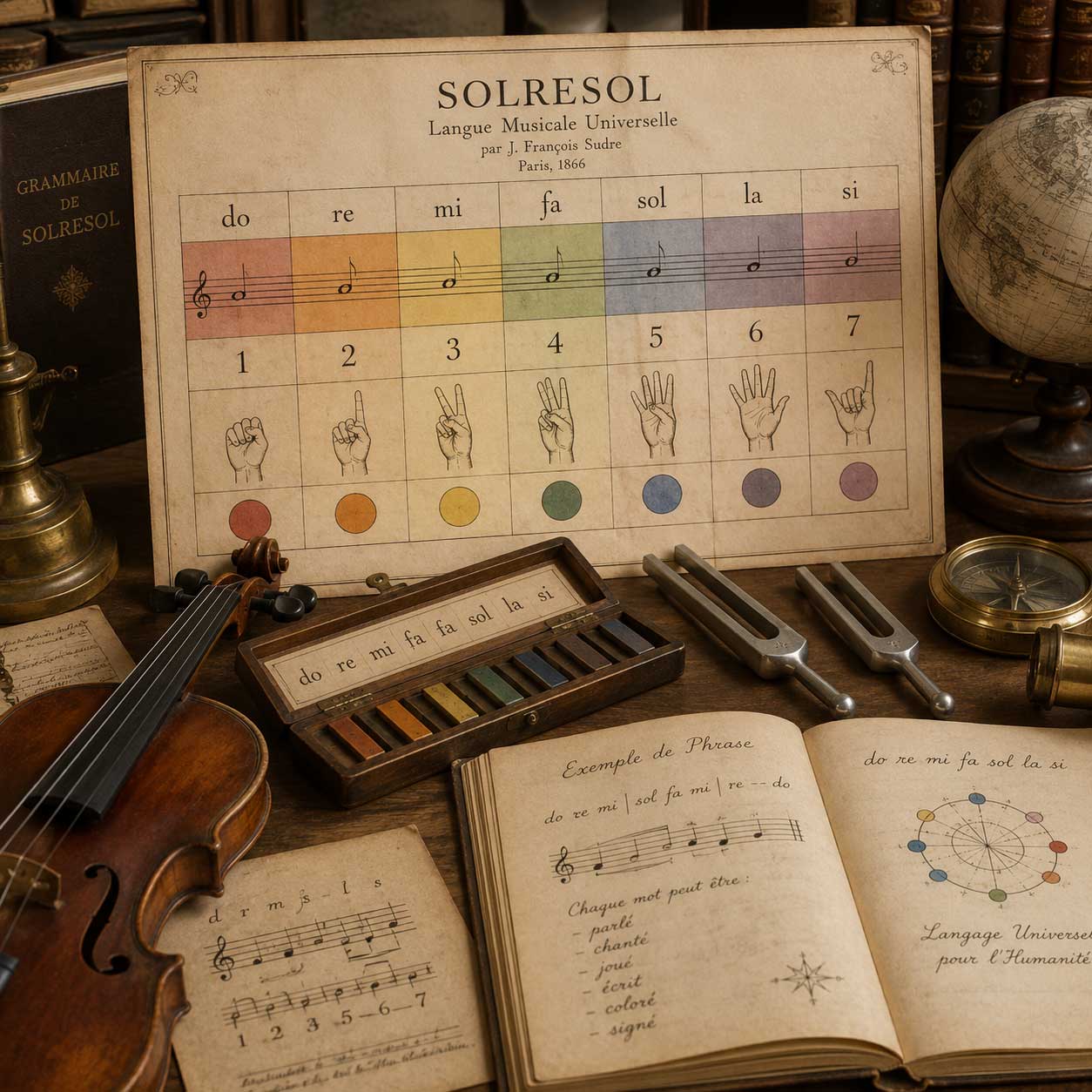
Across the original system and its later extensions, Sudre and later advocates matched each note with a spoken syllable, a musical pitch, a number, a colour, a written symbol or a gesture. The underlying sequence remained constant while the method of expression changed.
Someone could speak, sing or play a word made from do–mi–sol. The same person could write it as musical notes, represent it numerically or display it through three corresponding colours.
No single instrument controlled the message.
A violin could send it towards a flag.
Coloured marks could repeat a melody.
Gestures could reproduce a sentence first played on a piano.
Advocates presented this flexibility as part of the language’s universal promise. Different methods could help people who communicated through different senses or could not use the same medium.
Some nineteenth-century accessibility claims went beyond what modern evidence can support. Nevertheless, the underlying design principle remains striking.
Today, switching between text, sound, colour and gesture feels like a digital idea. Phones convert speech into writing. Software translates data into tones. Messages appear as vibrations, icons, captions, lights and notifications.
Solresol imagined this separation between meaning and medium before electronic communication became ordinary.
It treated language less like a voice and more like transferable information.
A Language That Could Be Seen
To make the musical language visible, each note could carry its own colour.
Do might become one colour, re another, and so on across the seven-note system. Someone could therefore turn a sequence of musical syllables into coloured shapes or marks.
This did not merely create an attractive way of decorating the language. It allowed people to preserve a message after its sound had disappeared.
A melody normally exists only while someone performs it. Once the final note ends, the sound is gone. By converting the notes into colour, a writer could preserve the same sequence on paper, fabric, signs or flags.
The idea also created the possibility of communication across distances. Coloured panels or flags could carry the same information that an instrument might otherwise play.
Solresol therefore blurred the distinction between a language, a musical composition and a signalling code.
A message could resemble a tune when listeners heard it, a painting when observers saw it and a numerical sequence when someone recorded it.
This gave the system an almost synaesthetic quality. Meaning could move between the senses while retaining the same internal structure.
One person heard a sentence; another saw it; a musician performed it.
Each encountered a different surface, but supposedly received the same thought.
The Problem with a Perfect Language
Universal languages usually begin by identifying everything untidy about existing ones.
Natural languages contain irregular verbs, duplicated words, inconsistent spellings, borrowed expressions and exceptions that appear to exist purely to inconvenience learners. A planned language can sweep these away and replace them with a clean system.
The problem is that people are not clean systems.
Solresol assumed that the seven-note musical scale offered a universal foundation. Music may be widespread, but musical cultures do not all divide sound in the same way. Sudre and his audiences knew the Western diatonic scale well, yet that familiarity did not make it culturally neutral.
The language also placed unusual demands on listeners. Sequences made from only seven recurring syllables could become difficult to separate and remember. During instrumental performance, musicians had to keep every difference in pitch clear. In spoken use, the system lost much of the musical feature that justified it.
Its carefully organised vocabulary created another difficulty. Grouping related words into similar patterns appears logical, but similar-sounding words can prove surprisingly easy to confuse.
A well-organised dictionary does not automatically produce an effortless conversation.
There was also the larger political problem faced by every proposed universal language.
A language does not spread merely because its design is clever.
It spreads through communities, institutions, trade, migration, government, education, conquest, fashion and habit. English is not internationally prominent because its spelling system won a competition for elegance.
Languages acquire power from the people and structures using them.
Solresol offered the world a solution before the world had agreed that Sudre’s particular problem needed solving.
The Language That Arrived Before Its Audience
Sudre died in 1862 without seeing his musical language adopted internationally.
His widow, Joséphine Sudre, published his major book, Langue musicale universelle, in 1866 and continued to promote his work.
The project did not immediately disappear. Supporters continued developing and reorganising it, and Boleslas Gajewski later published an influential grammar of Solresol in 1902.
By then, however, the competition had changed.
Other constructed international languages had appeared. Volapük attracted a substantial movement during the nineteenth century. Esperanto, first published in 1887, developed a community capable of writing, teaching, meeting and passing the language to new generations.
Esperanto still required learners to memorise vocabulary, but its words looked and behaved more like those of familiar spoken languages. Publishers could print it with ordinary letters, people could type it without musical equipment, and speakers did not have to distinguish long sequences of notes.
Solresol’s greatest distinction was also its greatest obstacle.
It was unlike almost everything else.
That made it fascinating to demonstrate, but difficult to make ordinary. A musical exchange could astonish an audience without persuading them to conduct tomorrow’s shopping, correspondence or family arguments through carefully separated note sequences.
Languages survive when people need them after the novelty has worn off.
Solresol never acquired enough ordinary life.
Why Solresol Refused to Go Silent
Solresol did not become the language of humanity, but it did not completely vanish.
It continues to attract constructed-language enthusiasts, musicians, programmers and others who enjoy alternative systems of communication. Modern users have digitised dictionaries, experimented with translators and proposed revisions to parts of its grammar.
Its continued appeal comes partly from the audacity of its original question.
What is a language actually made from?
We usually answer with words, sounds, writing and grammar. Solresol suggests a deeper answer: agreed distinctions make a language.
Those distinctions do not necessarily have to be letters. They could be notes, colours, movements, flashes of light or anything else that two people can reliably distinguish.
Morse code turns language into short and long signals. Braille represents it through patterns of raised dots. Sign languages use space, movement, orientation and expression. Computers reduce written, spoken and visual communication to encoded states that no human being directly experiences as language.
Solresol belongs beside these systems without being identical to any of them. Its ambition was not merely to encode an existing language.
It attempted to make the code itself into a new language.
That is why it remains more than a nineteenth-century curiosity.
Sudre failed to create the universal language.
But he succeeded in demonstrating that a sentence could leave the page, enter a violin, become a sequence of colours and still imagine itself to be the same sentence.
Most forgotten languages fall silent.
This one became silence, sound, colour and movement all at once.
Continue into Uncommonology®
One unusual idea often leads to another. Begin the free Initial Certificate of Uncommonology® and take your first step into the study of uncommon knowledge.
Start the free Initial Certificate →
Already enrolled, or ready to create your account?