
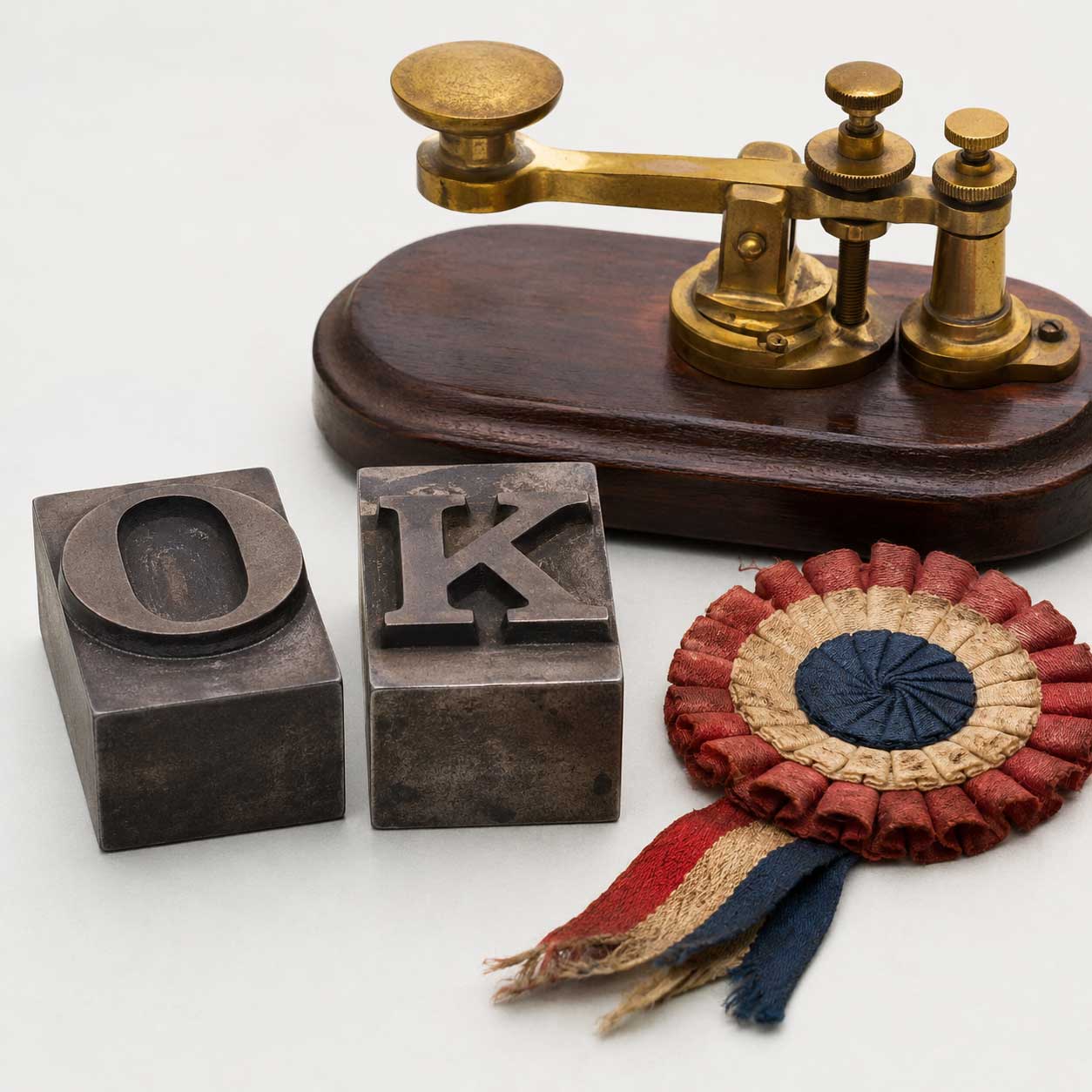
How Two Letters Conquered the World
“OK” is everywhere.
It approves payments, closes conversations, confirms appointments and reassures worried friends. It can mean yes, acceptable, understood, continue or simply I have nothing further to add.
Spoken warmly, it offers comfort. Spoken flatly, it may signal disappointment. Add a question mark—OK?—and it becomes a request for agreement, permission or reassurance.
For something so small, it performs an extraordinary amount of linguistic work. Yet the origin of OK is far less dignified than its global importance suggests.
One of the world’s most useful expressions began as a newspaper joke built from the deliberately incorrect spelling of two ordinary words.
The Origin of OK in a Newspaper Joke
During the late 1830s, newspaper writers in Boston developed a fashion for playful abbreviations. They reduced familiar phrases to initials, often after deliberately misspelling the original words.
The habit was rather like early internet slang. It was knowingly silly, briefly fashionable and funniest to readers who understood the game. Most examples disappeared almost as quickly as they arrived.
On 23 March 1839, editor Charles Gordon Greene used “O.K.” in the Boston Morning Post. The article explained it as an abbreviation of “oll korrect”, a comic misspelling of “all correct”.
Historians generally accept this as the earliest known printed appearance of the expression. Therefore, the origin of OK lies not in an ancient language or official code, but in the nineteenth-century equivalent of deliberate comic misspelling.
From Newspaper Joke to Political Slogan
The joke might easily have vanished with the other fashionable abbreviations. However, only a year later, it became entangled with American presidential politics.
Martin Van Buren, the eighth president of the United States, stood for re-election in 1840. He had been born in Kinderhook, New York, and his supporters used the nickname Old Kinderhook.
They formed O.K. Clubs that turned the initials into a political slogan. The coincidence worked perfectly: “O.K.” could refer to the candidate while also suggesting that he was “all correct.”
Campaign clubs, newspapers and political arguments carried the expression far beyond Boston humour. Van Buren lost the election, but the abbreviation linked to his campaign survived.
Consequently, Old Kinderhook was later mistaken for the origin of OK. The campaign did not invent the expression; it gave an existing joke a national audience.
Why the Wrong Explanations Survived
Once the newspaper joke had been forgotten, the tiny expression attracted a remarkable collection of alternative histories.
Some stories connected it to a military report meaning “zero killed.” Others proposed the Scottish och aye, the Greek ola kala, the Choctaw word okeh, or expressions from West African languages.
These theories often sounded plausible because the expression is extremely short. The sounds represented by O and K also occur in many languages, which made accidental similarities easy to find.
Political opponents added another false trail during the 1840 campaign. They claimed that former president Andrew Jackson marked documents “O.K.” because he could not spell “all correct.” Later research found no evidence that he created the abbreviation in this way.
The abundance of possible explanations made the real history harder to recover. A neat story could travel widely even when the supporting evidence was weak.
How Allen Walker Read Solved the Puzzle
The strongest historical case emerged through the work of American language scholar Allen Walker Read.
Read traced the expression through nineteenth-century newspapers and examined claims of earlier use. His research placed “O.K.” within the Boston craze for joking abbreviations and showed that the 1839 newspaper example came before the Van Buren campaign.
He also separated origin from popularisation. “Oll korrect” explains how the expression began, while Old Kinderhook helps explain why it escaped a short-lived joke and entered national use.
This distinction solved much of the mystery. Modern dictionaries and language historians now generally accept the newspaper explanation, although older stories still reappear.
In that sense, the history of OK is also a lesson in evidence. The most memorable explanation is not always the earliest or the best supported.
Why OK Outlived the Other Jokes
Hundreds of fashionable expressions appear and disappear. OK possessed several advantages that helped it survive its original moment.
First, it was brief. It was easy to write, easy to recognise and difficult to confuse with a longer message. Its compact form also suited the telegraph and the railway, where quick confirmation mattered.
More importantly, it was flexible. OK could express approval, acknowledgement, permission or simple acceptance without forcing the speaker to sound enthusiastic.
English speakers soon made it work as an adjective—“an OK result”—a verb—“the manager OK’d it”—a noun—“give me the OK”—and an interjection: “OK, let’s begin.”
The longer spelling “okay” later appeared beside “OK,” but neither form displaced the other. Both continued to carry the same unusually broad range of meanings.
How OK Became a Worldwide Word
OK eventually travelled far beyond American English. International business, popular culture, transport, technology and digital interfaces helped make it familiar across languages.
Its neutrality may be the secret of that success. “Yes” can sound definite. “Good” expresses judgement. “Agreed” announces a decision. By contrast, OK can perform all three jobs while remaining pleasantly vague.
It can celebrate success, tolerate mediocrity, calm a disagreement or close a conversation. Sometimes it means everything is correct. Sometimes it means nothing is especially wrong. Occasionally, tone makes it mean the opposite of the words themselves.
That flexibility allows two letters to do the work of a sentence. It also explains why a passing joke survived the newspapers, politics and technology of the nineteenth century.
The origin of OK may be comic, but its achievement is serious. A deliberately misspelled abbreviation became one of the most adaptable expressions in modern communication.
Not bad for something that was merely “oll korrect.”
Continue into Uncommonology®
One unusual idea often leads to another. Begin the free Initial Certificate of Uncommonology® and take your first step into the study of uncommon knowledge.
Start the free Initial Certificate →
Already enrolled, or ready to create your account?